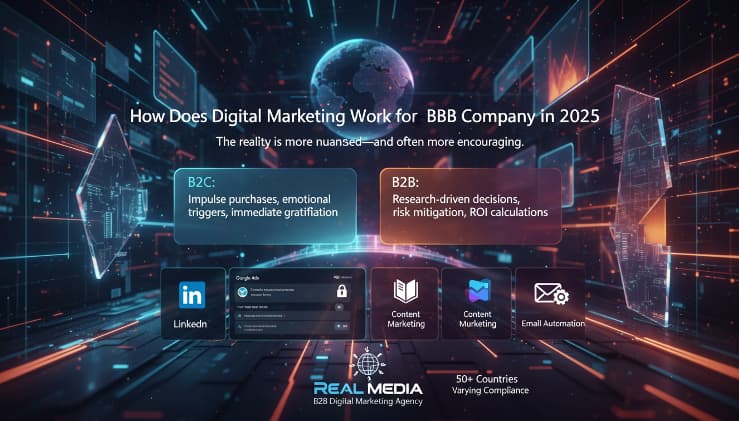
If you’ve landed here after reading countless “B2B digital marketing takes 2+ years to work” articles, take a breath. The reality is more nuanced—and often more encouraging—than the generic advice flooding LinkedIn.
Digital marketing works differently for different B2B companies. A SaaS company selling $500K enterprise contracts has a vastly different approach than a performance marketing agency serving iGaming clients. Let’s cut through the noise and explore what actually works.
At B2B digital marketing agency Real Media, we’ve seen firsthand how companies in regulated industries like iGaming, crypto, and fintech require fundamentally different strategies than traditional B2B approaches. The generic playbooks don’t work when you’re operating across 50+ countries with varying compliance requirements and advertising restrictions.
The Real Difference Between B2B and B2C Digital Marketing
The fundamental difference isn’t just “longer sales cycles” or “multiple decision-makers”—it’s about intent, education, and relationship-building.
B2C: Impulse purchases, emotional triggers, immediate gratification B2B: Research-driven decisions, risk mitigation, ROI calculations
But here’s what most articles get wrong: B2B sales cycles vary dramatically. Marketing agency services? 1-3 months. Enterprise software? 6-12 months. Multi-million dollar infrastructure? Sure, potentially 18+ months.
The key is understanding your sales cycle, not following a generic template.
The Multi-Channel Reality of B2B Digital Marketing
Forget the outdated advice that LinkedIn is your only channel. Here’s what actually works in 2025:
1. Paid Media with Strategic Targeting
Traditional paid advertising faces unique challenges in regulated industries. If you’re in crypto, iGaming, or finance, Google and Meta have strict policies. Smart B2B companies diversify:
- Native advertising platforms (Taboola, Outbrain) for thought leadership content
- Programmatic display with ABM tools for enterprise targeting
- Industry-specific platforms where your audience actually spends time
- Reddit and Quora advertising for niche technical audiences
The strategy isn’t just “run ads”—it’s creating campaigns that provide value at each funnel stage, not pushing contact forms to cold traffic.
2. LinkedIn: Strategic, Not Exclusive
Yes, LinkedIn matters for B2B. But treating it as your only channel is shortsighted.
What works:
- Thought leadership content from executives (personal brands convert better than company pages)
- Strategic connection building with decision-makers
- LinkedIn Sales Navigator for precise targeting
- Sponsored content to warm audiences, not cold prospects
What’s overrated:
- Mass InMail campaigns (response rates below 5%)
- Generic company updates nobody reads
- Treating it like a billboard for your services
3. Telegram, WhatsApp, and Direct Messaging Channels
If you’re operating internationally—especially in Eastern Europe, LATAM, or Asia—ignoring Telegram and WhatsApp is leaving money on the table.
These channels work for:
- Direct client communication across time zones
- Industry-specific groups and communities
- Faster response times than email
- Less formal relationship building
4. Community-Led Growth
Discord servers, Slack communities, specialized forums—wherever your target market congregates, you should have a presence. Not as a salesperson, but as a valuable contributor.
For technical products, GitHub presence matters. For crypto/Web3, Discord and Telegram communities are essential. For traditional B2B, industry-specific forums and associations.
5. Content Marketing That Actually Converts
Content marketing works, but not the way most companies execute it.
What’s outdated:
- 50-page white papers nobody reads
- Generic “Top 10 Tips” blog posts
- Gated content that adds no value
What works in 2025:
- Interactive tools: ROI calculators, cost estimators, assessment tools
- Short-form video: Yes, even for B2B. 60-second LinkedIn videos outperform 2,000-word posts
- Case studies with actual numbers: “We increased revenue 40%” beats vague success stories
- Problem-first content: Address specific pain points, not generic industry overviews
- AI-enhanced personalization: Dynamic content that adapts to visitor behavior
6. Email That Doesn’t Feel Like Spam
Cold email works when done right. The problem is most companies do it terribly wrong.
Traditional approach: “Hi [First Name], I hope this email finds you well…” Modern approach: Hyper-personalized, value-first, conversational
Use AI tools to research prospects, reference their recent work, and offer genuine value before asking for anything. Send 50 highly personalized emails, not 5,000 generic ones.
7. SEO for B2B: Targeted, Not Broad
SEO in regulated industries is challenging. Many high-risk verticals face advertising restrictions that make organic visibility crucial—but traditional SEO strategies don’t work.
Smart B2B SEO:
- Target ultra-specific long-tail keywords with buying intent
- Create location-specific content for multi-market operations
- Build topical authority through comprehensive content clusters
- Optimize for “near me” and geo-specific searches in local markets
- Focus on featured snippets and position zero
For niche B2B services, 20 highly qualified visitors beats 2,000 irrelevant ones.
AI-Powered Digital Marketing: The 2025 Advantage
Here’s what most “B2B digital marketing” guides miss entirely: AI has fundamentally changed the game.
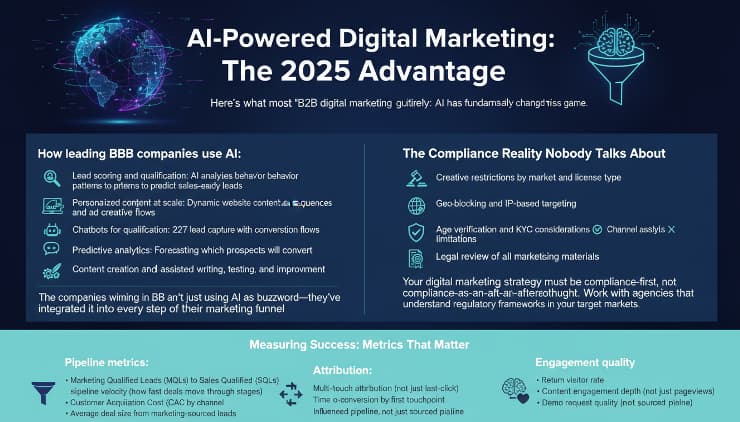
How leading B2B companies use AI:
- Lead scoring and qualification: AI analyzes behavior patterns to predict sales-ready leads
- Personalized content at scale: Dynamic website content, email sequences, and ad creative
- Chatbots for qualification: 24/7 lead capture with intelligent conversation flows
- Predictive analytics: Forecasting which prospects will convert
- Content creation and optimization: AI-assisted writing, testing, and improvement
The companies winning in B2B aren’t just using AI as a buzzword—they’ve integrated it into every step of their marketing funnel.
The Compliance Reality Nobody Talks About
If you’re in iGaming, crypto, finance, or other regulated industries, compliance isn’t optional—it’s foundational.
What this means for digital marketing:
- Creative restrictions by market and license type
- Geo-blocking and IP-based targeting
- Age verification and KYC considerations
- Platform-specific advertising limitations
- Legal review of all marketing materials
Your digital marketing strategy must be compliance-first, not compliance-as-an-afterthought. Work with agencies that understand regulatory frameworks in your target markets.
Measuring Success: Metrics That Matter
Forget vanity metrics. Here’s what actually indicates B2B digital marketing success:
Pipeline metrics:
- Marketing Qualified Leads (MQLs) to Sales Qualified Leads (SQLs) conversion rate
- Pipeline velocity (how fast deals move through stages)
- Customer Acquisition Cost (CAC) by channel
- Average deal size from marketing-sourced leads
Attribution:
- Multi-touch attribution (not just last-click)
- Time-to-conversion by first touchpoint
- Channel assist analysis
- Influenced pipeline, not just sourced pipeline
Engagement quality:
- Return visitor rate
- Content engagement depth (not just pageviews)
- Demo request quality (not just quantity)
- Sales acceptance rate of marketing leads
The Hybrid Approach: Events Still Matter
Digital doesn’t mean virtual-only. For B2B, especially in industries like iGaming, fintech, and tech, in-person events remain crucial.
Modern event strategy:
- Industry conferences for networking and brand presence
- Hybrid events with virtual components
- Private dinners and VIP experiences for high-value prospects
- Webinars that actually deliver value (not thinly-veiled sales pitches)
- Regional meetups in key markets
The ROI isn’t always immediate, but relationships built at events often lead to long-term partnerships.
Referral Programs: The Underutilized Channel
B2B referrals can account for 40-60% of new business, yet most companies have no formal referral strategy.
What works:
- Partner referral programs with clear incentives
- Client advocacy programs
- Strategic partnership development
- Integration partnerships for ecosystem expansion
Digital marketing should support and amplify your referral efforts, not replace them.
The Real Timeline for B2B Digital Marketing
Let’s be honest about timing:
Month 1-3: Foundation building, testing, data collection Month 3-6: Optimization based on initial data, first real results Month 6-12: Scaled campaigns, consistent pipeline generation Month 12+: Predictable, optimized system with clear ROI
The companies that fail expect immediate results. The companies that succeed understand they’re building a system, not running a campaign.
Common Mistakes That Kill B2B Digital Marketing
1. Treating all B2B the same: Your strategy must match your specific industry, deal size, and sales cycle
2. Over-relying on one channel: Diversification protects against algorithm changes and market shifts
3. Ignoring existing customers: Retention and upsell are easier than new acquisition
4. No lead scoring: Not all leads are created equal—prioritize based on fit and intent
5. Generic messaging: “We help businesses grow” says nothing. Specific pain points and solutions convert
6. Forgetting mobile: B2B decision-makers use mobile devices—optimize accordingly
7. No sales and marketing alignment: These teams must work together, not in silos
Building Your B2B Digital Marketing Stack
Essential tools for 2025:
- CRM: HubSpot, Salesforce, or Pipedrive for pipeline management
- Marketing automation: For email sequences, lead nurturing, and scoring
- Analytics: Beyond Google Analytics—tools like Mixpanel for deeper insights
- ABM platform: For enterprise targeting (if applicable to your business)
- AI tools: ChatGPT/Claude for content, various AI tools for personalization
- Social listening: Track mentions and conversations in your industry
Don’t over-invest in tools before you have strategy and processes in place.
The Bottom Line
Digital marketing works for B2B companies when approached strategically, not tactically. It’s not about doing everything—it’s about doing the right things for your specific business.
The companies succeeding in B2B digital marketing in 2025 are those that:
- Understand their specific sales cycle and buyer journey
- Leverage multiple channels strategically
- Use AI and automation intelligently
- Focus on quality over quantity
- Measure what matters
- Stay compliant in regulated industries
- Build genuine relationships, not just generate leads
Digital marketing isn’t a magic bullet, but executed correctly, it’s the most scalable way to generate predictable B2B revenue.
Ready to build a digital marketing strategy that actually works for your B2B company? Start with clarity on your ideal customer, map their journey, choose channels where they actually spend time, and commit to consistent execution over at least 6-12 months.
The results won’t happen overnight, but they will happen.